
CRACKS IN THE MACHINE
Assembly races show candidates and voters willing to challenge the status quo


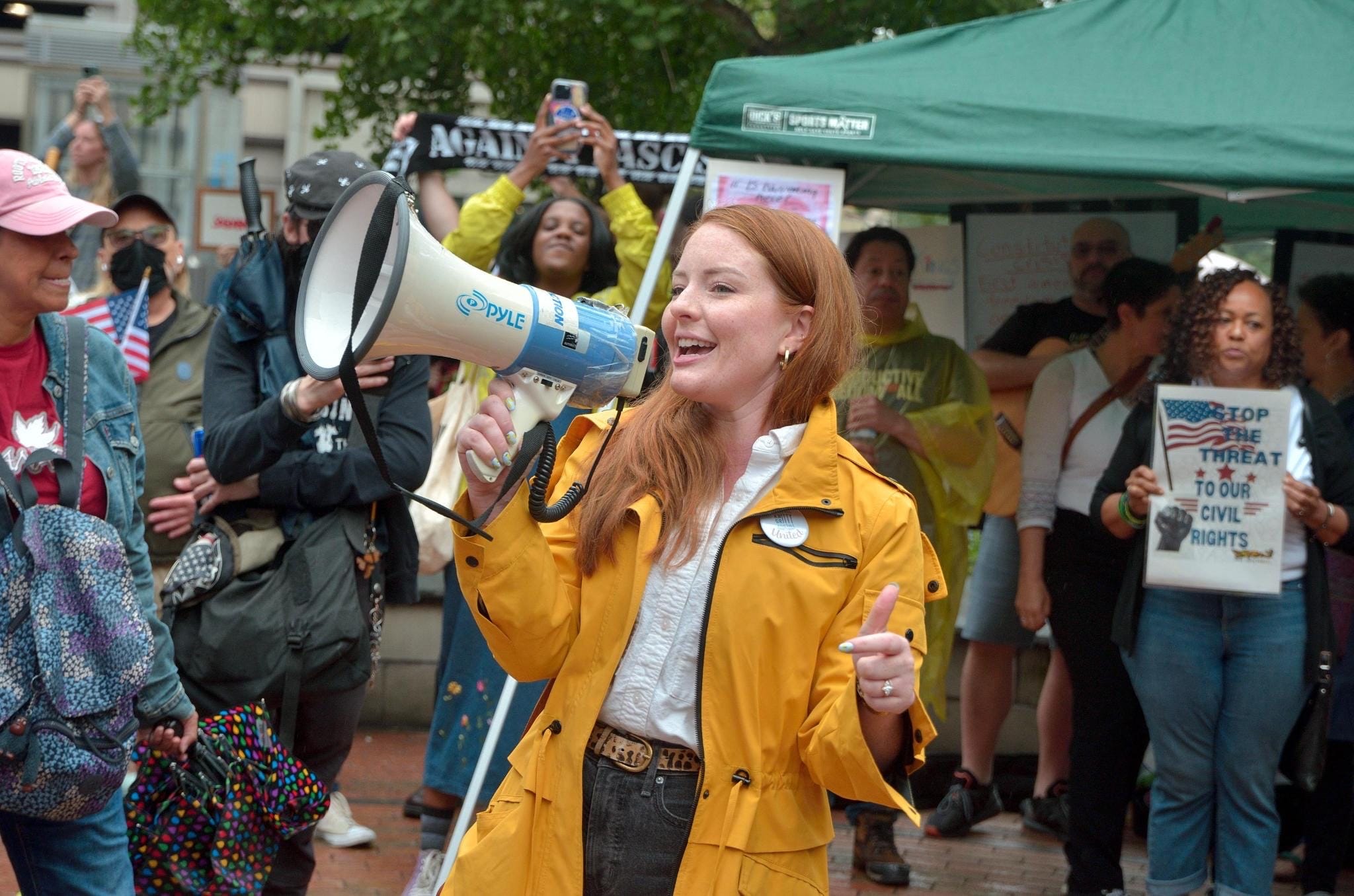
Katie Brennan campaigning.
Something virtually unheard of happened in last Tuesday’s primary for the New Jersey Assembly: a handful of candidates won, or came close to winning, over Democratic county machine-backed candidates in heavily blue districts. Some candidates ran explicitly against the county party organization; others ran over objections of the party leaders; and still others, though embraced by the party machine, intend to pursue their own agenda.
It’s not the end of machine politics, not by a long shot, and political leaders still have money and organizational muscle to put behind candidates.
Statewide, according to the New Jersey Election Law Enforcement Commission (ELEC), incumbents had a huge cash advantage against challengers, and much of that money came directly or indirectly from the county machines. (In turn, of course, a huge chunk of money raised by the county machines came from big contractors doing business in the county.) ELEC reported in a press release on June 6 that incumbents, nearly all of whom were party-backed, had raised $20.8 million, while challengers raised $5.5 million.
But it is no longer a slam dunk that voters will go along with whomever the bosses anoint.
“I definitely think those Assembly races are significant. It's even more difficult to win against the endorsed candidates down ballot because there is less name recognition, so the county endorsement may carry more weight. There have not historically been a lot of challenges in the Assembly and even fewer upsets to the county line candidates,” Julia Sass Rubin, a Rutgers University professor, told The New Jersey Democrat.
Since winning the Democratic primary in these districts virtually guarantees a win in November, there are likely to be four or five independent Assembly members next year. How will this change party politics and what will it mean for pressing more progressive legislation on housing, healthcare, taxation and other issues?
“It may be enough to move the needle ever so slightly in the direction of fairness,” Justin Shoham, campaign manager for Ed Rodriguez, who won Union County’s LD 20, told TNJD. “You can make the argument that our state party has suffered because of the establishment influence. All you have to do is look at the general election results of 2024. I went to bed in a blue state and woke up in a purplish state. I have to think that had to do with the fact they were too machine-y. Our party can use a good work-out, and the way it does that is by inviting new voices into the room.”
Perhaps the race that most shakes up the power of the machine was in Jersey City, in Hudson County’s LD 32, where two candidates of the supposedly strong Hudson County Democratic Organization came in fourth and last in a field of six. The winners, housing expert Katie Brennan and Hoboken Mayor Ravi Bhalla, ran specifically against the party apparatus, declaring they were “not beholden to the machine.”
Running independently meant they were free to speak their mind and advocate for what they believe in, Lou DiPaolo, spokesman for Katie Brennan, told TNJD.
“Voters appreciated having candidates who meant what they said and said what they meant. Katie and Ravi built authentic connections with voters, and that's a direct result of being independent from the machine. They took principled positions — even on issues some candidates might see as risky, like congestion pricing or resisting Trump early in his term — instead of waiting for a poll or consultant to tell them it was safe to speak up.”
They put together a grassroots campaign which included environmental groups like Food and Water Action, local community groups including Journal Square Neighborhood Association and they had the backing of the Working Families Party. Volunteers from these groups and others who live in the community and were inspired by the candidates, along with Brennan and Bhalla, went canvassing door-to-door, knocking at thousands of homes.
And because these grassroots advocates believed in the candidates’ message and because Brennan and Bhalla themselves spoke with voters, they convinced people they were sincere. “It makes a big difference when it’s the candidate or a dedicated volunteer talking to voters instead of a paid canvasser,” DiPaolo noted, contrasting their campaign with that of party machines.
“If Democrats are looking for a new playbook,” said DiPaolo, “just look at what Katie and Ravi were able to do here. They were unapologetically themselves and they weren't afraid to speak their minds, and that level of authenticity really landed with voters. Their independence is how they were able to energize volunteers and build the type of broad-based coalition that ultimately won the race.”
In the adjoining Hudson County district, LD 31, Assemblywoman Barbara McCann Stamato, lost by some 228 votes in a district where over 31,600 votes were cast, to the machine’s candidate. She was the incumbent but lost the machine’s backing for re-election. She ran an independent campaign allied with gubernatorial candidate Steve Fulop, who ran his gubernatorial campaign on an explicitly anti-machine platform.
Before the line was eliminated, machine-backed candidates were rarely challenged in a primary and were virtually guaranteed re-election in blue districts. They stayed in office for years. “What happens when you run on the line for years is that they don’t know how to run a campaign because they win automatically,” one campaign manager for an independent campaign told TNJD.
But now the losses and near misses to outsiders may force machine politicians to actually talk with constituents, something that “would be an earthquake for NJ,” Professor Rubin noted at a post-primary panel discussion by the Eagleton Institute of Politics. “We saw from some of the incredibly unpopular bills that went through the legislature over the past couple of years, the Open Public Records Act (OPRA) and the Election Transparency Act, that when the leadership said ‘vote this way,’ most legislators voted that way because they haven’t had to worry about their constituents. So, if there’s an understanding that you can’t assume you are going to get re-nominated in the primary because it’s no longer a given, and you have to actually go out and talk to your constituents, that makes you less willing to vote against [the constituents’] wishes. One hopes, anyway.”
That indeed was the message Loretta Rivers tried to drive home in her campaign to unseat the author of one of those bills. Running in LD 17 in Middlesex/Somerset Counties, Rivers, a school board member and nonprofit director from Piscataway, targeted the machine-backed incumbent, Assemblyman Joe Danielsen for being the author and chief sponsor of the OPRA, a bill New Jersey Comptroller Kevin Walsh warned would lead to “more corruption, fraud, waste, and abuse.”
Rivers, a first-time candidate, came within 500 votes of Danielson, who has been in the Assembly since 2014, and Rivers won in Piscataway. She ran on the ticket with gubernatorial candidate Steve Fulop and was backed by the Working Families Party, Food and Water Action, and a local community group, the Piscataway Progressive Democratic Organization.
And how did voters respond to Rivers criticism of Danielsen? “I can tell you that when I knocked on doors on her behalf, people knew what I was talking about,” Stacy Berger, chair of the Piscataway Progressive Democratic Organization told TNJD. “It was inspiring and very affirming that people understood they have a right to the records that their tax dollars pay for and that one of their elected officials chose not to advocate for that.” Berger said Rivers, who was also speaking to voters about the need to have more diverse representation for the district, was massively outspent by the machine and a dark money PAC. Berger believes “if she had a little more money or started earlier it would be a different story.”
In Union County’s LD 20, Eduardo Rodriguez, director of planning and community development for the City of Elizabeth, decided to run for the Assembly against the incumbent, Reginald Atkins. But he didn’t expect to run on his own or expect it to cost him his job.
But when Rodriguez indicated his interest in running, the powers that be in Elizabeth and forces within the Union County Democratic Organization said they would not support him, according to political insiders. In fact, he learned he would not get re-appointed to his city post. “These guys are not used to you saying you want to do something and then if they say no, you are going to do it anyway. When these people said no, it was over, because if you were off the line you weren’t going to win, so nobody would ever do anything like that.”
Instead of stepping away from running for Assembly, Rodriguez left his job and used his own money to finance a campaign. “We set out to run a campaign outside the power in the (district’s) four towns,” Shoham, his campaign manager, told TNJD.
The county machine reportedly felt Atkins was not up to the job of defeating Rodriguez and Atkins suddenly decided not to seek re-election. Instead, the county machine backed Union County Commissioner Sergio Granados to run against Rodriguez for the Assembly. Rodriguez won by 98 votes.
Another surprise win over the party machines was that of Kenyatta Stewart in LD 35, which runs through parts of Passaic and Bergen Counties. Stewart is 1,301 votes ahead of his nearest opponent, more than the ballots left outstanding. Stewart is Newark Corporation Counsel and a close ally of Newark Mayor Baraka.
“This is definitely a wake-up call for the Passaic County Democratic Party,” one of Stewart’s supporters, former county commissioner Theodore Best told the Bergen Record. “The leaders of the Democratic Party need to listen to what the people want.”
In LD 28, which includes parts of Essex and Union counties, Chigozie Onyema won handily over the incumbent, Garnet Hall, who lost the party backing. Onyema, as TNJD detailed previously, won the backing of LeRoy Jones, a wealthy lobbyist and chairman of both the Essex County Democratic Committee (ECDC) and the New Jersey state Democratic committee. But Onyema also had the support of progressive groups, including Working Family, Citizen Action, and CWA.
For Onyema, who says he opposes machine politics, it’s all about enacting progressive policies. His aim, he told TNJD, is “filtering the most progressive ideas through all the spaces that we’re in. Part of my goal is to be involved in the electoral process and try and shift the political center. And I think there are others who might say I’ll organize from the outside. I work in nonprofit advocacy professionally and I’m trying to figure out how we can push the biggest, boldest policies across the country. In electoral politics I’m trying to figure that out in District 28 and in Newark and the state legislature.”