
DATA CENTERS UNDER FIRE
Activist groups, municipalities demand moratoria and bans on AI centers. But is Governor Sherrill getting the message?


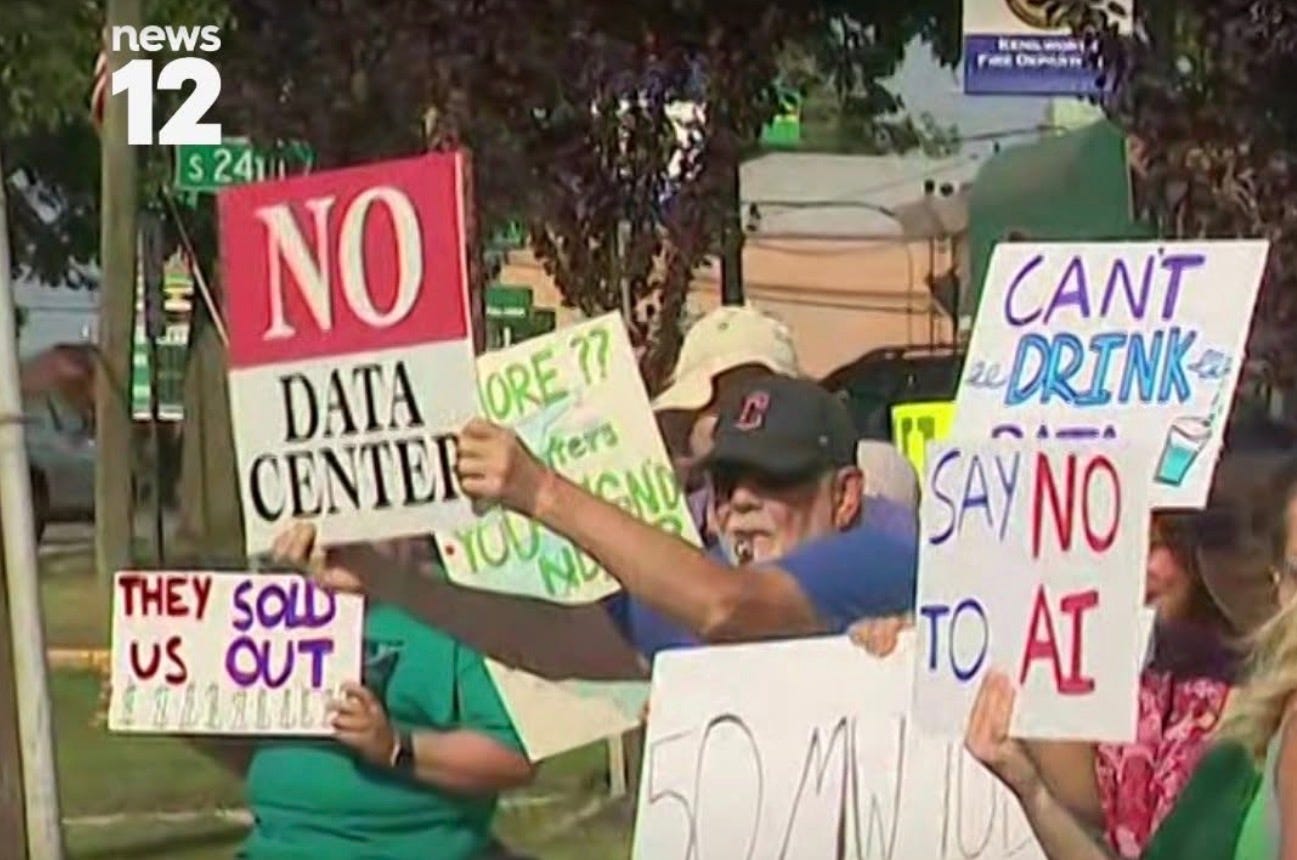
Data center protesters in Kenilworth.
Across New Jersey the backlash against data center construction is gaining momentum, with 20 municipalities passing ordinances banning data centers in their towns in the last six months. And members of New Jersey’s congressional delegation have started to warn about data center growth and to support a moratorium on data center construction. But whether Governor Mikie Sherrill, whose signature campaign issue was her pledge to halt rising utility bills, is willing to take on data centers, a main driver of these rate hikes, is an open question.
“It’s pretty clear that the AI industry in New Jersey is on its back foot,” Ben Dziobek, executive director of Climate Revolution Action Network New Jersey (CRAN), a climate-focused advocacy group, told The New Jersey Democrat. “There is an intense amount of local pressure, hundreds of people are showing up at council meetings across the state every single day,” he said. CRAN has worked in most of those 20 towns to pass the bans and is involved with 40 more municipalities where officials are working to do the same.
“There’s never been a more bipartisan issue,” Dziobek added. People throughout the state are growing more and more concerned that data centers, especially the supersized ones now being planned, create enormous electricity and water demand and present major environmental issues, he said.
“We see a large uptake in these ordinances to ban data centers,” Heidi Yeh, policy director for the Pinelands Alliance, told TNJD. “It’s bipartisan. Residents universally recognize the threat that this poses to their community.” Even town leaders who initially seemed receptive to them have shifted, she said, “once public pressure is put on them.” She cited Monroe Township in Gloucester County, which in 2025 voted to allow data centers as well as warehouses on the open land that Hexa Builders wanted to develop, but reversed course a year later after strong public opposition followed submission of the company’s actual plans.
In May, 60 organizations, led by the Pinelands Alliance and including dozens of other environmental groups, unions, progressive organizations and civil rights groups, sent a letter to Sherrill calling on her to declare a moratorium on approving and building data centers “until regulations or legislation are implemented to protect ratepayers and consumers, maintain electric grid reliability, and minimize environmental impacts.”
The coalition has been circulating a petition to the governor too, with more than 7,500 signatures, calling for a temporary halt on further data center construction.
The letter cited an April poll by Fairleigh Dickinson researchers showing 65 percent of New Jersey residents want such a ban until more power plants are built to provide data center energy needs.
“I think that letter for us was a really strong pressure point to start having these conversations and with the governor’s office and pushing new methods and tactics,” said Dziobek.
Indeed, a few days after the letter went out, the governor issued what she said was the “first comprehensive plan to tackle” data center impact on energy demand, resource use and local communities. Her plan would set “guard rails” for future data center growth,” she said.
Its four pillars are:
“Establishing fair-share rules to ensure data centers bring new clean energy online and contribute to grid infrastructure needed to support their growth, shifting costs away from residents and ratepayers rather than to them…
“Improving transparency starting with requiring reporting on energy and water use…
“Developing strong statewide standards for community benefit agreements … ensuring data centers address added impacts like light, noise and pollution while making meaningful local investments…
“Delivering good paying jobs [at] prevailing wages.”
But these goals would require regulations and legislation, and the governor has not detailed any measures she wants enacted to implement them. “It is all formative, we have to wait and see,” said an attorney with a major New Jersey law firm who’s been monitoring Sherrill’s proposal. And meanwhile data centers are filing construction plans and hiring builders.
The administration did announce on June 23 that it was reassessing a key policy that Governor Phil Murphy’s administration backed to jumpstart data center construction. The New Jersey Economic Development Agency (EDA) said it was reassessing the $500 million tax credit for companies building data centers signed into law by Murphy two years ago. The announcement came on the day that an Assembly committee was marking up legislation to kill these same tax credits.
Sherrill’s EDA announced on its website that it was “temporarily pausing the acceptance of new applications while it conducts a review of the program. During this period, no new applications will be accepted.” The only company that has benefited so far from the tax credits has been CoreWeave, which in November was awarded $250 million over five years to construct a $1.8 billion AI data center in Kenilworth in Union County.
Whether the EDA will end the benefit remains to be seen. “The NJEDA is committed to supporting this emerging industry and the economic opportunities it can create for New Jersey residents, such as good-paying jobs. However, being a leader in AI innovation must be done in concert with Governor Sherrill’s efforts to ensure data centers operate responsibly and within strong, transparent guardrails,” EDA spokesman Chris Flores told NJ.com.
Jeff Tittel, former director of the New Jersey Sierra Club, doesn’t think much of the governor’s guardrails. He slammed Sherrill’s plan. “These are not guardrails. They are green lights,” he said in a June 19 commentary for The Jersey Vindicator. “Her proposal contains no meaningful restrictions on where data centers can be built, no limits on their water consumption, no caps on their energy use, no new environmental protections, no new siting regulations, and no moratorium on approvals while the state studies their impacts. What Governor Sherrill is offering is not regulation, standards, or legislation. It is political cover.”
Environmental leaders continue to push for bans at the local level and a statewide moratorium, in order to have time for a detailed discussion of how to regulate the industry. There are numerous bills in different stages of moving through the legislature that address the various problems with data center development, including job displacement, water usage, energy consumption. But even if they are passed and signed by the governor, they will take time to implement.
“We don’t view those as sufficient,” the Pineland Alliance’s Yeh said, with regard to Sherrill’s guardrails. “They’re basically half measures that are also coming too late and many of them focus on reporting. Simply knowing how much water and electricity data centers are using doesn’t actually limit how much they can use. It doesn’t actually limit the damage from happening.”
She cited the moratorium on development in the Pinelands, that preceded passage of the Pinelands Protection Act, as a model for what is needed now. The moratorium allowed time to set up the Pinelands Commission and draw up a management plan. The moratorium “allowed judicious, prudent planning to create this plan that has been successful throughout the decades,” she said. “It would have been hard to thoughtfully craft all of that if the bulldozers were actively working. So, a moratorium really was the right move there, and we think that it’s the right move again today.”
Sherrill’s guardrail plan “really doesn’t go far enough and perfectly exemplifies why we need a two-year moratorium,” said Dziobek. “The biggest issue out of the bunch for data centers is energy usage. Her plan would put a tariff in place that would raise funds for infrastructure and have data centers pay for their own electrical grids and upgrades that are necessary to run these facilities and connect them to our grid. [But] that would take two years to put into effect.”
In March, Senator Bernie Sanders and Representative Alexandria Ocasio-Cortez announced a campaign for a national moratorium on data center construction, to allow for a broad debate on oversight. “We cannot sit back and allow a handful of billionaire Big Tech oligarchs make decisions that will reshape our economy, our democracy, and the future of humanity,” said Sanders. (The Washington Post, which is owned by Jeff Bezos of Amazon, which is spending tens of billions of dollars on data centers, in an editorial called it “Bernie Sanders’s worst idea yet.”)
Ocasio-Cortez introduced the Artificial Intelligence (AI) Data Center Moratorium Act on June 24, a companion bill to one Sanders introduced earlier in the Senate, which would halt data center construction so that laws could be adopted dealing with their role in increasing utility bills, environmental pollution, and job loss, and to also ensure that any wealth created by AI is shared with ordinary people. Representative Bonnie Watson Coleman of New Jersey is one of its nine co-sponsors.
At a congressional hearing on June 24 Representative Frank Pallone of New Jersey also called for a national moratorium on AI data centers “until we can find a way to ensure they don’t harm our nations’ air, water and power bills.” Pallone said that his constituents were way ahead of Congress on this. “Towns in my district are ahead of Congress in seeking a moratorium. Asbury Park, Red Bank, Old Bridge and Sayreville all have taken this bold step. The City of New Brunswick put a stop to a data center plan after the community stood together to oppose the project.”
Exactly how much energy and water do data centers consume? “Data centers were the main driver of the 20 percent jump in electric bills that New Jerseyans experienced in June 2025,” according to a study, Fool’s Gold: The Hidden Costs of AI Data Centers for New Jersey, by New Jersey Policy Perspective, a progressive thinktank. “By 2030, nearly 10 percent of New Jersey’s entire electrical usage will go to data centers, or the equivalent of the energy usage of the entire state of Rhode Island.” The report said data center growth not only led to higher utility bills but “increased air pollution in environmental justice communities, strain on water resources and minimal long-term job creation despite state subsidies.”
A recent PSE&G report said that in 2025 the company had 39 data center sites and the peak summer demand for those sites was 394 MW. But, said the company, “PSE&G is projecting an increase of the demand of its data center customers to 3,084 MW by the Summer of 2031.”
The letter sent by the 60 organizations to Sherrill calling for a moratorium explained how this compares with ordinary residential use.
Much of the current data center debate involves mega or hyperscale data centers using 100 MW of energy or more, such as the projects in Vineland and Kinnelon. 100MW is enough electricity to power roughly 80,000 households. The Vineland project will use 300MW and the Kinnelon project 250 MW. But even a 20 MW data center uses as much electricity as all the homes in Montclair. There are already dozens of data centers operating in New Jersey that use 20 MW of power, and many data center owners own multiple sites whose combined demand often exceeds 100MW. For example, CSquare operates three facilities in Piscataway, Weehawken, and Secaucus with combined 127.2 MW usage.
But while environmental groups, progressive unions, and grassroots organizations want to slow down the rush to create data centers, the business community and construction unions want to speed it up.
Michele Siekerka, president of the New Jersey Business & Industry Association and Bernie Corrigan, president of the electrical workers union, the IBEW, a key part of the building trades, are working together to counter the opposition to data centers. They wrote a joint article in NJ.com criticizing communities that reject data centers. Instead, they argued, “we should be positioning ourselves as a leader in AI innovation at exactly the moment that position is worth something.” And the NJBIA and IBEW called on lawmakers to reject legislation that would eliminate the state tax credit for data centers. “New Jersey should be strengthening its position as a destination for these projects rather than withdrawing incentives before the program has had an opportunity to mature… For organized labor, data center development represents a source of high-quality construction and reliable skilled trades employment.”
It's nonstop lately! Detention centers. Data centers. ICE. AI. Tariffs. Iran. Trillionairs and cuts to healthcare. Threats to our voting rights. Women losing our rights... Is it just me? I don't remember ever living with so many attacks on every facet of life all at once. And we're celebrating 250 years of our Republic? Stephen King couldn't come up with a plot like this.