


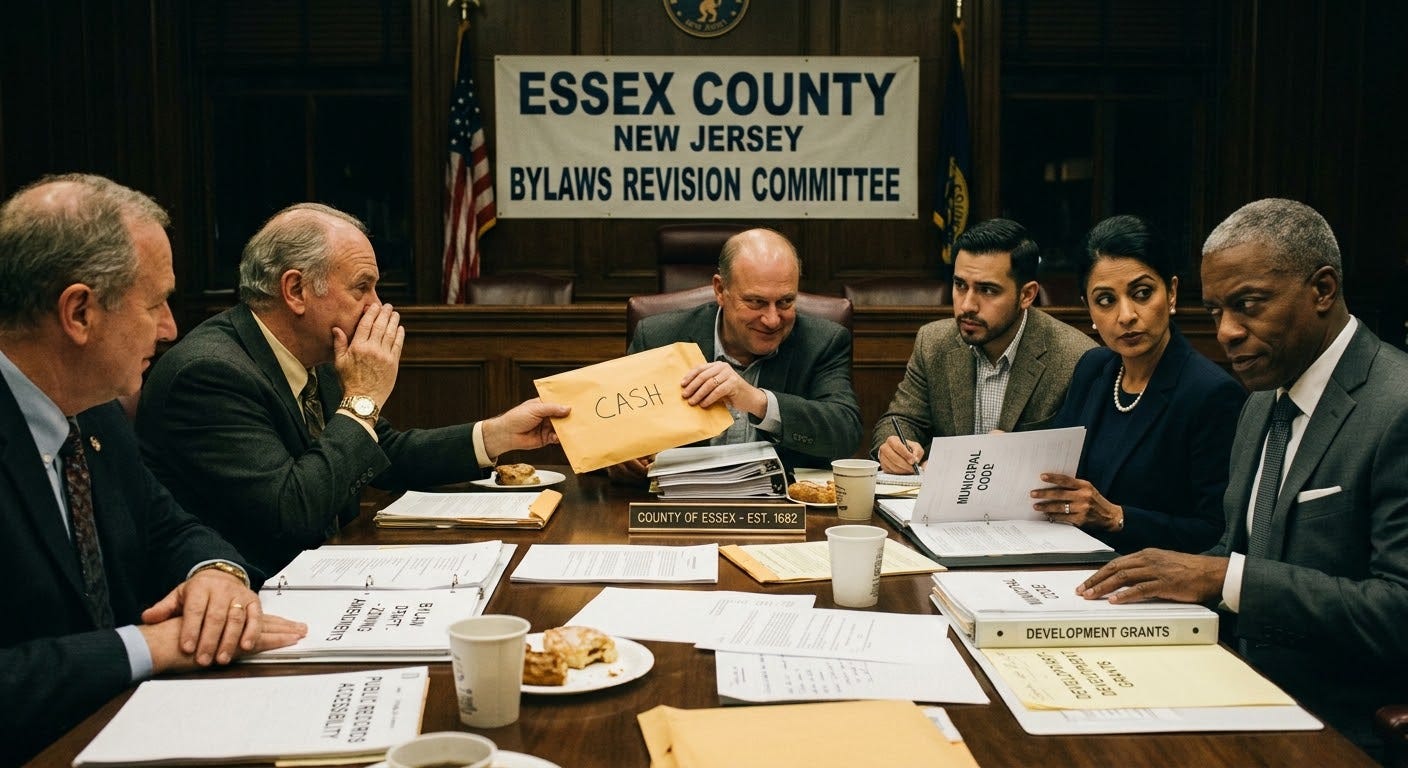
UPDATE: The October 21 meeting was indefinitely postponed by the ECDC, following widespread protests. (See the article below for details on the opposition that was building to LeRoy Jones’ power grab with the rigged bylaws.) Stay tuned for further news in this developing story.
How does a New Jersey political machine try to perpetuate its control over local politics, shore up its declining monopoly power, and try to guarantee that an array of party bureaucrats can continue to impose their will on Democratic voters and elected officials in the state’s second largest county? Start by rewriting the rules.
With the end of the “county line,” the ballot-rigging mechanism that allowed political machines to back chosen candidates, those machines are wobbling. So, a two-year-long scheme to rewrite the Essex County Democratic Committee’s bylaws, which operated behind closed doors – even while keeping some of its decisions from the Bylaws Committee members themselves – sets up the ECDC to consolidate power around its chairman, LeRoy Jones.
But, while Jones and the executive committee of the ECDC may have expected that the new set of bylaws intended to govern the ECDC’s internal workings would quietly pass muster and be enacted smoothly at the committee’s in-person meeting on October 21, they are instead facing a growing revolt against the new bylaws.
That opposition is coming from at least two municipal Democratic committees, in South Orange and Maplewood, from the nascent ECDC Progressive Caucus, from Essex Reform Democrats, and within the ad-hoc bylaws committee itself. Some elected district leaders (DLs), who are rank-and-file members of ECDC, see the new bylaws as a power grab by Jones, ECDC’s chairman. And because the new bylaws will require a two-thirds vote in favor in order to take effect, it’s possible that the opposition could block them and force a rewrite.
Opponents particularly object to sections that remove the current provision that prohibits the ECDC from using party funds to support favored candidates in Democratic primary elections, give the ECDC chairman the power to make endorsements at his “sole discretion,” and make it next to impossible for ECDC members to place business items on meeting agendas. The new bylaws also eliminate two important oversight committees, the Finance Committee and the Campaign Committee, and do away with the requirement for an annual financial review by an independent auditor, instead placing the power to approve outlays “as approved by the Chair.” (See below for a more detailed description of the proposed bylaws.)
“These proposed bylaws changes were clearly written with intent to reduce participation and silence committee members,” Joe Rospars, co-chair of both Essex Reform Democrats (ERD) and the South Orange Democratic Committee, told The New Jersey Democrat. “They raise new, preposterously high barriers for any district leader to be heard on or even just get an up-or-down vote on anything that the chair doesn’t already support. It’s a document geared towards giving more unilateral power to the chair, reducing oversight and accountability, and loosening financial controls.”
“After reviewing the draft that was circulated, I realized that instead of progress, the amended bylaws actually strip out many of the processes and compliance safeguards that previously existed,” Ritu Pancholy, the co-chair of the South Orange Democratic Committee (SODC), told The New Jersey Democrat. Like Rospars, Pancholy is also co-chair of ERD.
“Collectively,” she added, “SODC reviewed the amended bylaws and uniformly agreed to pass a resolution asking the county to table the proposed amendments until our viewpoints are heard – or, alternatively, we encourage other municipalities and DLs to vote no on the amended bylaws as drafted.”
A resolution by the Maplewood Democratic Committee (MDC), which has so far won unanimous support from its members, “calls upon the leadership of the Essex County Democratic Committee to postpone final consideration of the proposed bylaws and to take no final vote until elected county committee members have been given a meaningful opportunity to review, discuss, and propose amendments to them.” If the ECDC insists on moving ahead with an up-or-down vote on October 21 without any changes to the flawed draft, the MDC resolution “urges elected county committee members to vote against adoption.”
Last week, Laura Valente, the designated chair of the ECDC’s Progressive Caucus, contacted several dozen members of the caucus by email after the proposed bylaws were revealed. “I am extremely disconcerted by the number of deletions, additions, and omissions that significantly harm the democratic operation of the County Committee,” she wrote. “These changes are, frankly, anti-progressive as they seek to limit the power of the elected District Leaders.”
Since then, Valente, who is also president of Nutley Democratic Action, has reached out by phone and email to Jones; to Akeem Cunningham, the ECDC executive director; and to the two co-chairs of the ad hoc Bylaws Committee, Phil Alagia, Essex County chief of staff, and Saily Avelenda, a long-time senior New Jersey Democratic party official, asking them whether there would be an opportunity between now and October 21 to suggest changes in the bylaws proposal, to no avail. “I didn’t elicit any sort of assurance that further comments or discussion would take place,” she told TNJD.
And it appears that the Bylaws Committee itself, which began its work more than two years ago – though it seemed to disappear for long periods of time, with no meetings or discussion at all – managed to keep its members in the dark. In background conversations with The New Jersey Democrat, members of the committee said that some of the most troubling provisions in the proposed bylaws were not discussed or considered by the committee as a whole. Asked about the provision that gives Chairman Jones the power to make endorsements at his “sole discretion” if the ECDC fails to achieve a quorum, one Bylaws Committee member told TNJD, “I have no idea what you’re talking about. I don’t remember any conversations about that at all.”
Perhaps that’s because some of the provisions were added quietly, and at the last minute. David Huemer, a Maplewood DL and a member of the Bylaws Committee, wrote to the other members of the committee suggesting exactly that. In a September 28 email, obtained by TNJD, Huemer let them know that he’d be voting against the proposed bylaws. He wrote:
The proposed By Laws may not receive the 2/3rds vote needed at the Special Meeting. Most of the opposition stems from deletions or changes added after the 9/23/24 original draft. Many of these deletions and additions were not discussed by our committee. If there are no significant changes in the proposed By Laws by October 21st, I will not be voting to approve.
And, yes, you read that right: the first draft of the bylaws was prepared more than two full years ago.
Anti-democratic changes
All in all, it’s a case study in how a boss-run political machine is trying to rejigger the rules after absorbing a body blow in 2024. That’s when the infamous “county line,” a long-entrenched procedure that allowed county party machines, both Democratic and Republican, to rig primary election ballots for favored sons and daughters, was eliminated. That change, which drastically weakened the historic ability of county party committees to tilt local politics in favor of the party organization, has led to a proliferation of candidates in primaries and to a healthy expansion of small-d democratic give-and-take in both local and state politics.
No wonder, then, that in rewriting ECDC’s bylaws – last written way back in 2003 – that Jones & Co. would attempt to fix the game, and to restore at least a modicum of the machine’s power that was lost in 2024.
Among the changes in the proposed set of new bylaws, several key provisions have drawn fire from Democratic committees in South Orange and Maplewood and from Essex Reform Democrats, a caucus within ECDC that was established earlier this year.
First, under the existing bylaws, the ECDC is flatly prohibited from spending money and using its resources on behalf of any Democratic candidate running in a primary. That, of course, is intended to ensure that the party apparatchiks cannot weigh in to back a particular candidate to tilt the playing field in favor of the chosen candidate. That provision, currently in effect, reads:
The Essex County Democratic Committee and any entity controlled by the Essex County Democratic Committee or the Officers thereof, shall not receive or expend funds to be spent in furtherance and in aid of the candidacy of any candidate in a primary election.
But in the new, proposed bylaws, that provision has been eliminated. And it was deleted with no explanation, meaning that beginning in 2027, when every seat in the state Senate and the Assembly will be contested, the party bosses will be allowed to weigh in.
Second, in a measure that one county Democratic official said stunned her, the new bylaws added a provision saying that if a county endorsement convention fails to achieve a quorum – in this case, meaning that at least 35 percent of the county’s elected district leaders are in attendance – then the county boss alone can make endorsements: unilaterally, without consulting the convention attendees, without discussing it with other party officials. The proposed provision reads:
If … the Overall Quorum is not met, the Chair shall have the right to confer the ECDC endorsement on any candidate, in the Chair’s sole discretion.
In other words, Jones, as ECDC chairman, could anoint candidates for each and every office on his own – and then, according to the provision noted above, spend unlimited sums of ECDC cash on their behalf. (And, under the misguided Elections Transparency Act of 2023, donors – including contractors doing business in the county – can contribute up to $118,000 each to the county party coffers.)
It’s important to note, as well, that there’s no reason why the ECDC, or other county committees, should make endorsements at all in primary elections. Why should bureaucrats in the party machine put their thumbs on the scale, rather than allow candidates to compete against each other in the public sphere? (The Democratic National Committee, for instance, does not make endorsements in U.S. presidential primaries.)
Third, what if a substantial number of elected members of the ECDC want to bring up a proposal or suggest an amendment at a party convention or meeting? In the past, a group of 50 district leaders could submit in advance a proposal for an agenda item or amendment, and as long as it was received far enough in advance the full ECDC would be required to consider it. And previously, the committee members signing the petition could do so virtually, electronically. Under the new proposed bylaws, however, a much more onerous system would be put in place. “Signatures,” the new bylaws read, “must be wet and not electronic.”
In other words, organizers proposing a new “item of business” would have to track down and meet, in person, with scattered district leaders, collect a “wet” signature – that means in ink, the old-fashioned way – and deliver those signed papers to the ECDC. Not only that, they’d have to do it under time pressure, since meetings are not often announced far in advance, and the signatures would be required to be delivered “at least seven (7) days prior to the date” of the meeting.
Valente, the Progressive Caucus chair, said that taken together, these and other provisions of the new bylaws will discourage involvement in county politics by members of ECDC. “Whether intentional or not, this is going to reduce participation.” She compared it to efforts by President Trump and the GOP in places like Texas, where the state government has sought to suppress votes by reducing the number of drop boxes for mail-in ballots. “They say, ‘You just have to drive to that drop box,’ right? ‘We’re not making it impossible; we’re just making it a whole lot harder.’ And that’s what it feels like here.”
Not mentioned in the proposed bylaws are provisions that would apply to ethical and conflict-of-interest issues concerning the ECDC chairman, the vice chairs, or other members of the ECDC executive committee.
As readers of The New Jersey Democrat know, TNJD has repeatedly written about the fact that key Democratic party leaders, including Jones, Kevin McCabe of Middlesex County, Brendan Gill, and others serve as politicians as well as lobbyists and government relations executives. TNJD’s very first piece, in January 2025, described LeRoy Jones’ role as a principal with 1868 Public Affairs, and we’ve followed that up with a series of stories about 1868’s lobbying work on a wide variety of issues on behalf of wealthy clients and major corporations.
In June, members of Essex Reform Democrats, a caucus formed in February 2026, sought to have ECDC’s bylaws amended to preclude the chairman and other ECDC officials from serving as lobbyists, as owners of companies that employ lobbyists, or as owners of companies that do business with the county. Those proposals, along with others, were submitted in writing to ECDC in advance of its reorganization meeting on June 17, 2026.
In its communication with ECDC on June 10, Essex Reform Democrats said:
The proposals consist of 15 individual modifications to the by-laws, each individually signed onto by more than the 50 district leaders required (their districts and email contacts are included). We seek a vote by the full committee on each one individually.
But on June 16, Victor Afanador, an attorney for ECDC responded, saying that the 15 proposals would not be considered at the reorg meeting because they had not been received in a timely manner. However, Afanador wrote:
The proposed amendments, however, will be issued to the By-Laws committee for consideration at a future meeting to be scheduled by the Chairman. Please be advised that for the last year the By-Laws committee has been working on a series of amendments to the By-Laws and will consider these amendments in its overall proposal to the ECDC.
The 15 proposals were forwarded to the Bylaws Committee – and voted down. Jones, in particular, opposed the provision concerning his role as a lobbyist.
“The committee leadership clearly hopes that no one bothers to actually read the proposal and understand the changes,” said Rospars. “Essex Reform Democrats plan to help fellow district leaders find out what’s actually in these proposed bylaws and, based on what we’re seeing so far, it’s going to make them mad. And rightfully so: at a time when Democrats should be leading on issues of accountability and fairness, and opposing the corruption, self-dealing, and nepotism of the Republicans, our Essex County Democratic leadership is too often doing the exact wrong thing.”
Bob Dreyfuss, one of TNJD’s co-editors, is a district leader in Maplewood and a member of Essex Reform Democrats.
A long, long time ago I was a member of the Bronx County Democratic Committee.
For me this is Deja Vu all over again.
Morris County Democratic Committee (morrisdems.gov) uses Ranked Choice Voting for their Nominating Conventions in stark contrast to the direction things seem to be heading at ECDC