
‘MAKE POLLUTERS PAY’ ACT ADVANCES
But enactment is uncertain, and tough legal challenges await


Note: Thanks to all of our readers who’ve opted for a paid subscription! From today on, we’re no longer offering paid subscriptions, and going forward all subscriptions will be free. We didn’t start this publication as a business, and we don’t pay ourselves salaries. But all of our expenses have been covered. We’re very grateful to those who’ve opted to pay monthly or annually. Please keep reading!
Minutes before midnight, the state Senate Budget and Appropriations Committee on Sunday evening cleared the way for the state legislature as a whole to take up the “Polluters Pay to Make New Jersey Affordable Act,” also known as the Climate Superfund Act. At the tail end of a rushed, multi-hour session of the committee, which conducted a revolving-door series of votes on dozens of bills, only a handful of people were given one-minute time limits and allowed to testify, led by a pair of critics of the bill and including an overlong oppositional testament from Senator Mike Testa, a right-wing Republican from Vineland.
But it passed.
The bill (S2338) – and its Assembly companion bill (A3735), which had previously cleared committee hearings, too – would require fossil fuel companies that have emitted at least one billion metric tons of greenhouse gases worldwide since 1995 to share a $50 billion liability, spread over the next two decades, paid directly into the coffers of the New Jersey state treasury. The two bills have wide support in the state legislature, with 43 Assembly and 19 Senate co-sponsors.
But the bill’s future is uncertain, and even some of its co-sponsors have expressed doubts about its scope and cost. And, even if enacted, the companies involved, along with their allies in the conservative legal community, will fight to overturn it in the courts.
Facing strong opposition from business and industry groups, from conservative trade unions allied with oil and gas firms, and from Republicans who don’t believe the science that shows that global warming is both real and human-caused, the two bills are backed by more than 100 statewide organizations, including Clean Water Action, Climate Revolution Action Network, unions NJEA, SEIU 32BJ, and CWA, NJ Citizen Action and the Working Families Party, NJ Food and Water Watch, Make the Road NJ, Indivisible groups, and many others.
Whether it gets an up-and-down vote in the legislature this week depends on Assembly President Craig Coughlin and Senate President Nick Scutari. Backers are optimistic. “This is a historic opportunity for lawmakers to show that they’re fighting to lower costs for New Jersey families,” said Antoinette Miles, the executive director of the NJ Working Families Party. “When big polluters don’t pay, we all do. This is about fairness and making our state more affordable for working people, not big corporations.”
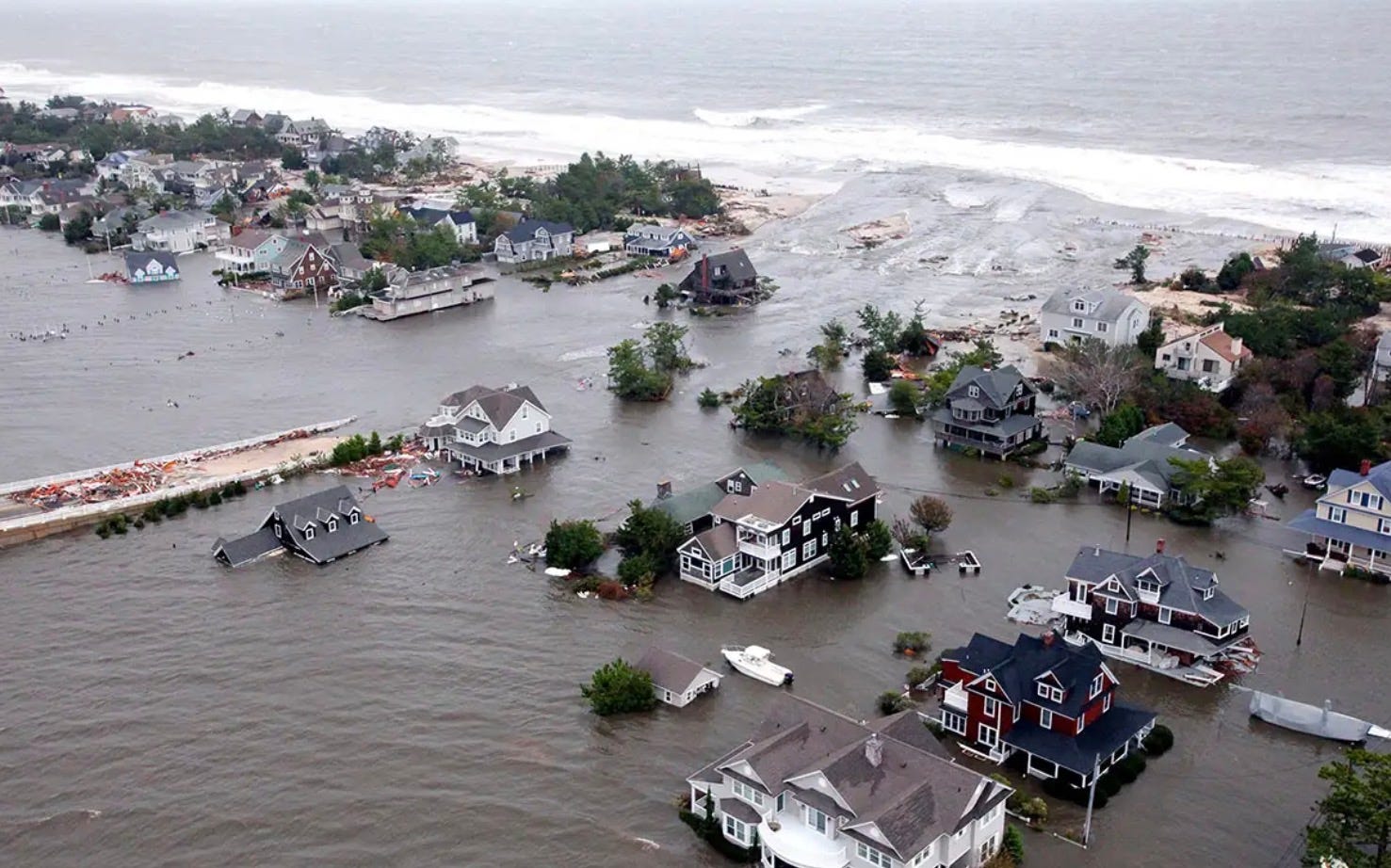
The theory of the legislation is that heat waves, intense storms, flooding, rising sea levels and related climate disasters have cost New Jerseyans tens of billions of dollars in reconstruction costs, repairs, higher utility bills, insurance costs, and rising property taxes. Superstorm Sandy in 2012 alone cost New Jersey more than $30 billion, according to the Sierra Club.
“Working class families are already paying the price for climate change. The communities hit the hardest are the ones who can least afford the cleanup,” said Nedia Morsy, the director of Make the Road NJ. “This is how we protect the little guy against some of the biggest and most profitable corporations on the planet. With the federal government cutting disaster aid, it’s up to states like New Jersey to step up.”
The bill’s backers point to the fact that both New York and Vermont have enacted similar legislation. About a dozen other states, including California, Oregon, Maine, and Virginia, are considering climate superfund laws, according to the NRDC, and there’s possible federal legislation in the works, too.
The New York version, however, signed into law by Governor Kathy Hochul in December 2024, is tangled up in implementation and it has yet to collect a dime from targeted companies. The New York version is intended to levy $75 billion over 25 years from huge firms such as ExxonMobil, BP, and Chevron that have ties to the state. And, although the law sets a 2028 deadline for collection, an avalanche of business lawsuits and constitutional challenges is expected. According to Knauf Shaw LLC, a law firm:
Many have suggested that the Act presents constitutional concerns as potentially violating the prohibition against “ex post facto laws,” that is, penalizing conduct that was not illegal at the time. The Supreme Court has made a distinction between the application of the concept of ex post facto in the criminal and civil context, although the distinction might not be clear with a statute like this one, as the Court has intimated that some laws imposing liability could be so punitive in nature as to be considered criminal, in effect.
And how to apportion the costs among dozens of fossil fuel companies will be exceedingly complex. In New Jersey, backers say that 82 firms are targets of the bill, though none of them are headquartered in New Jersey. In New York, the state plans to base its levies on the amount of greenhouse gases issued by polluters over the years 2000 to 2024, treating those emissions almost as if equivalent to barrels of toxic waste. An analysis by the Columbia Law School in 2024, related to four climate superfund bills in New York, Vermont, Massachusetts, and Maryland, said:
Together, the four Climate Superfund bills seek hundreds of billions of dollars from the largest fossil fuel companies. These Super-emitters, along with sympathetic political and industrial organizations, states, and/or municipalities, will inevitably challenge the Climate Superfund bills in court. Plaintiffs will likely assert a variety of claims, and invoke an overlapping array of constitutional principles, that challenge both the authority of states to regulate GHG emissions and the proportionality and propriety of the Climate Superfund bills.
And it adds:
Another challenge could attack the liability structure of the Climate Superfund bills, and argue that states lack a rational basis for the total amount of liability assigned to each Super-emitter. The Due Process Clause restricts statutes that impose or limit liability for economic activity if they are “demonstrably arbitrary or irrational.” … These bills may be vulnerable to Due Process challenges because they do not clearly articulate a connection between these infrastructure costs and the harms caused by each liable Super-emitter to the state.
Vermont, the first state to enact a climate superfund law in May 2024, has found its legislation tangled up in a complex legal battle. One lawsuit involves the American Petroleum Institute, the U.S. Chamber of Commerce, and 24 red-state attorneys general, and there’s a federal lawsuit filed by the Trump administration and the EPA. The result of the litigation could set a precedent for New York’s law and, if enacted, New Jersey’s, too. Its legality is being defended by the Conservation Law Foundation and others. According to One Earth Now:
The stakes are significant on both sides of this battle. Should Vermont ultimately lose, it would mean that the state’s taxpayers and residents continue having to foot the entire bill for responding and adapting to climate disasters. It would also likely mean the end of similar climate superfund laws or proposals in other states. Fossil fuel polluters would enjoy continued impunity and exorbitant profits while the costs of climate-fueled extreme weather balloon and further burden already-strained municipal and state budgets. If the fossil fuel industry and its allies lose this fight, then companies like BP, Chevron, ExxonMobil and others would be subject to billions of dollars in liability under not only Vermont’s law but other states like New York’s too.